Wan 2.7
Alibaba's open video family: Wan 2.7 set the 15-second standard, Wan 3.0 and 3.0 Prime now do 30-second single takes with native sound for a few cents per second.
At a glance: Wan. The live spec card, price calculator and Generate button show here on the site.
Wan 2.7, Wan 3.0, Wan 3.0 Prime — what is what
Wan is Alibaba's video model line and the one most open-source video tools are built on. Wan 2.7 was the workhorse of early 2026: 15-second clips, image-to-video, strong motion, weak sound. Wan 3.0 doubled the length to a 30-second single take, added native audio generated with the picture, and introduced omni references — up to 20 assets (images, clips, audio, and oddly useful, documents). Wan 3.0 Prime is the same model with a higher-quality sampler: cleaner faces, steadier long takes, about 60% more per second.
In the Lab the video studio runs Wan 3.0 and 3.0 Prime (the Wan 2.7 model lives in the image studio as a still generator). Everything in this guide applies to the version you can click right now.
Wan is the cheapest serious video model in the video studio: a 5-second clip is 26 credits, a full 30-second take is about 156. Draft here, finish here, or draft here and finish on Kling or Seedance.
How Wan reads a prompt
Wan likes plain, physical language and one clear camera idea. It is less tolerant of adjectives than Veo and far cheaper to iterate, so write short and run twice. Reference assets are named in the prompt by role — the courier from the character reference, the street from the location reference.
- One line for the shot — subject, action, camera.
- One line for the world — place, time, light.
- One line for the sound — ambience, then any dialogue in quotes.
- Optional beats — 0–10 s / 10–20 s / 20–30 s for long takes.
Mid shot on a courier on a bicycle, one slow push-in down a neon-lit alley, rain falling through the key light. Night, wet asphalt, pink and blue signs. Sound: rain, tires hissing, distant traffic.
Wan tops out at 1080p. If the deliverable is 4K, generate the frame in Wan and upscale, or use Seedance 2.0 / Kling 3.0 for the final.
Every setting in the studio, explained
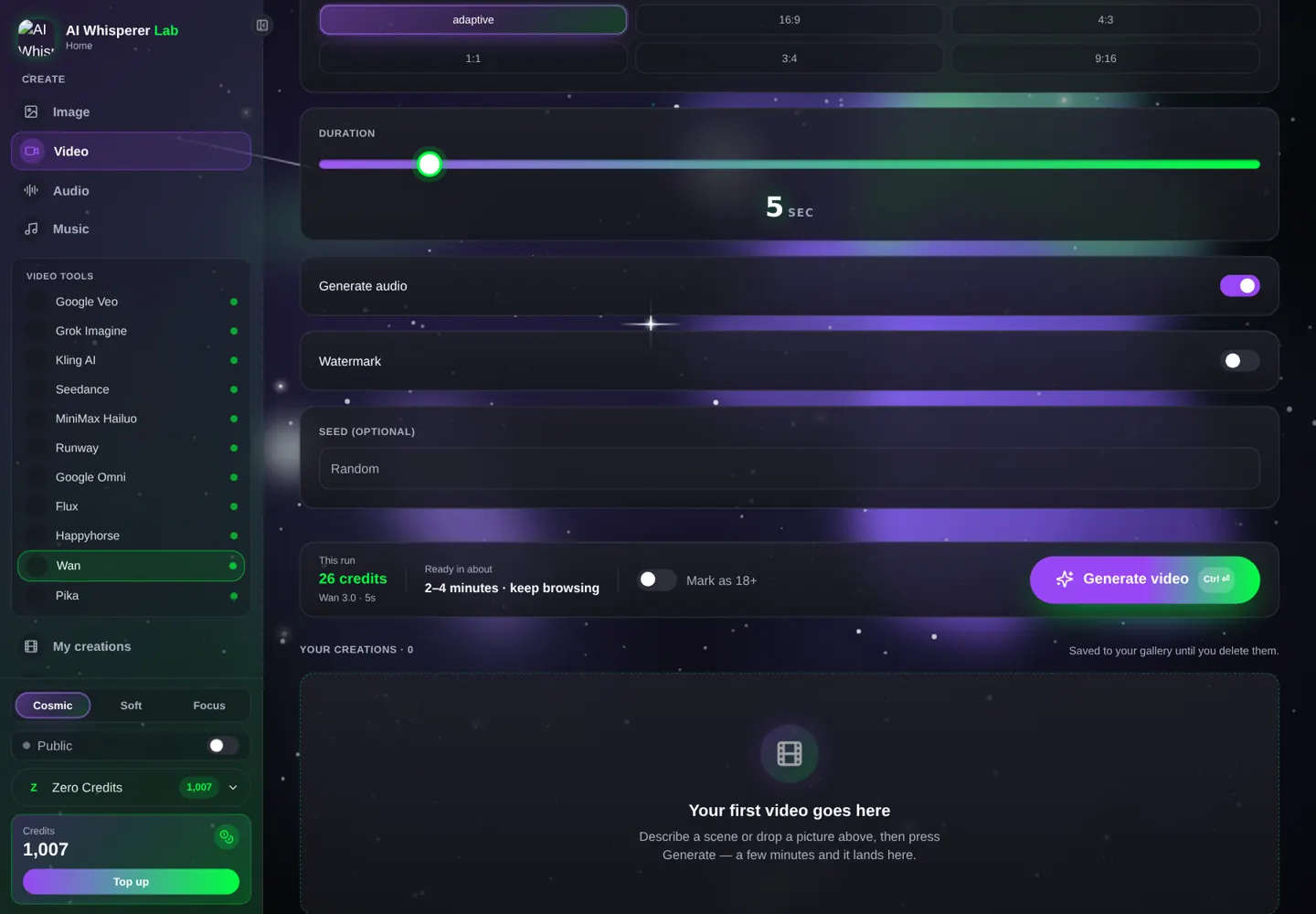
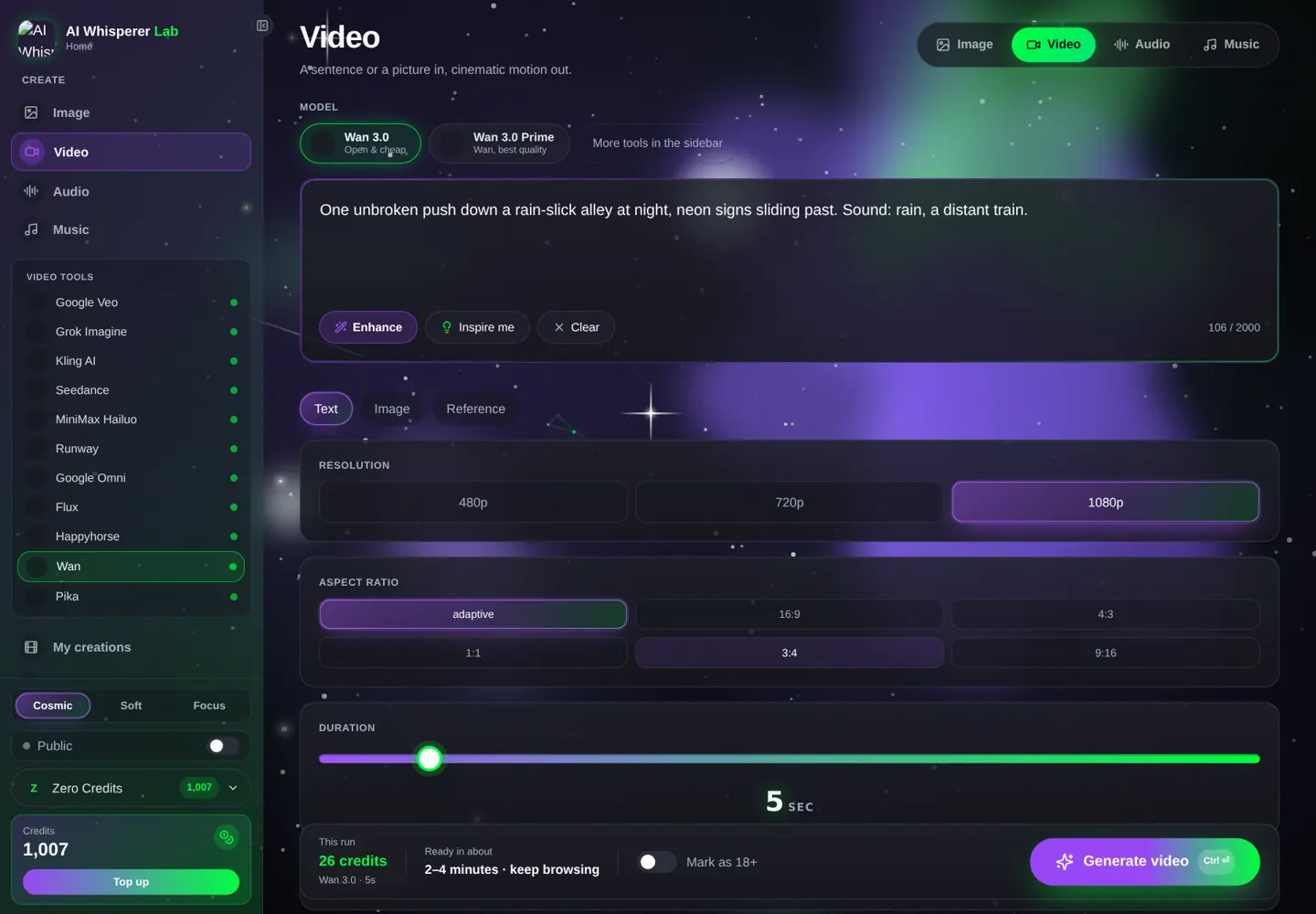
- Model — Wan 3.0 (cheapest) or Wan 3.0 Prime (cleaner).
- Length — type 4–30 seconds, or Auto to let the model end when the action ends (billed as 10 s).
- Resolution — 480p for tests, 720p for social, 1080p for delivery.
- References — up to 20 files: photos of a person, a product, a place; short clips for motion; audio for a voice or music bed. Name each by role in the prompt.
- Image to video — attach one image and describe only the motion; Wan keeps the frame.
Your first Wan clip, step by step
- Open the video studio, pick Wan, then Wan 3.0.
- 720p, 5 seconds, 16:9.
- Paste the prompt below — 26 credits.
- Generate. Then change one word (time of day, camera move) and run again; at this price you can afford five variations.
- For the final, switch to Prime and 1080p.
One unbroken push down a rain-slick alley at night, neon signs sliding past on both sides, puddles reflecting pink and cyan. Sound: rain, a distant train.
12 prompts you can run right now
Long single takes (Wan 3.0, 20–30 s)
A 30-second single take: the camera glides at walking pace along a morning fish market; vendors lift crates of ice, a cat weaves between stalls, sunlight reaches the wet floor by the end. Sound: ice, shouts, gulls.
A 20-second continuous shot: a woman opens a café, flips the sign, turns on the lights one by one, starts the espresso machine, and the first customer appears at the door. Warm interior, blue dawn outside. Sound: keys, switches, the machine warming.
A 25-second slow orbit around a brushed steel kettle on a stone counter as it comes to a boil, steam building, the whistle starting on the last seconds. Studio light. Sound: water heating, then the whistle.
Short and cheap
A paper boat floats down a rain gutter, the camera tracks alongside at ground level. Overcast soft light. Sound: running water.
A hummingbird hovers at a red feeder, wings a blur, the camera holds a static macro. Bright garden light. Sound: wing hum, birds.
Aerial glide over rice terraces at sunrise, mist in the valleys, a farmer walking a ridge. Sound: wind, a distant bell.
With sound and dialogue
A cellist finishes a phrase in an empty church, lowers the bow and holds still as the last note decays; the camera drifts slowly left. Sound: the cello's decay, a long reverb tail.
Medium shot, a mechanic wipes her hands, looks at the camera and says: "It'll start now." Garage, hard overhead light. Sound: a wrench set down, a distant radio.
Two hikers at a summit, one says: "Worth it?" the other exhales and nods. Wide shot, wind moving jackets, late light. Sound: wind, breath.
References (attach files first)
The courier from the character reference crosses the plaza shown in the location reference, 3/4 tracking shot, evening. Sound: footsteps, pigeons.
Studio-lit rotation of the product from the reference image, logo legible throughout the turn, black background, 10 seconds. Sound: soft whoosh.
Use the voice from the audio reference. A radio host in a small studio, headphones on, says: "You're listening to the late shift." Warm light, static. Sound: room tone.
Documents to video — the odd feature that saves time
Wan 3.0 accepts a PDF, a slide deck or a text file as a reference and uses it as the script and the visual brief. Drop in a one-page product sheet and write "a 20-second spot that follows the document", and it will structure the shots around the headings. It is a rough first draft, not a finished ad — but at 26 credits per 5 seconds it is the cheapest storyboard you will ever make.
Wan (image) → Wan 3.0 (frame first)
Cinematic still of a neon-lit alley in the rain at night, pink and cyan signs, wet asphalt, 16:9, no people.
Animate the reference: the camera pushes slowly forward; rain intensifies; a cyclist crosses at the end. Sound: rain, a bell.
Wan drafts → Kling / Seedance finals
Use Wan to find the shot: five variations for under 150 credits. Take the winning prompt to Kling 3.0 (dialogue, 4K) or Seedance 2.5 (references, 30 s at 1080p) for the final.
Wan → ElevenLabs
For a narrated spot, keep Wan on ambience only and add a studio voice from the audio studio.
Every morning starts somewhere. This one starts at the harbor.
Mistakes that waste credits
- Expecting 4K. Wan ends at 1080p.
- Adjective piles. Wan takes them literally and gets muddy. Physical nouns and verbs.
- Unnamed references. Say which reference is the character and which is the place.
- Auto length for short ideas. Auto bills as 10 seconds; set 5 if you only need 5.
- Skipping Prime on faces. Close-ups of people are where Prime earns its 60%.
What it costs, what it takes
| Model · settings | Credits | About | Typical wait |
|---|---|---|---|
| Wan 3.0 · 5 s | 26 | $0.26 | 1–2 min |
| Wan 3.0 · 30 s | 156 | $1.56 | 3–5 min |
| Wan 3.0 Prime · 10 s | 82 | $0.82 | 2–3 min |
| Wan 3.0 Prime · 30 s | 245 | $2.45 | 4–6 min |
Compare: 30 seconds on Seedance 2.5 at 1080p is roughly 2,900 credits. Wan is where you learn, iterate and make the bulk of your B-roll.
FAQ
What is the difference between Wan 2.7 and Wan 3.0?
Wan 3.0 doubles the length to 30 seconds, adds native audio and up to 20 references. Wan 2.7 remains a strong image model and 15-second video model; the Lab runs 3.0 and 3.0 Prime for video.
Does Wan generate sound?
Wan 3.0 does — ambience, effects and spoken lines, generated with the picture.
How long can a Wan video be?
Up to 30 seconds in a single take on Wan 3.0 and Prime.
Can Wan do 4K?
No. 480p, 720p and 1080p.
What does Prime change?
A higher-quality pass: cleaner faces and steadier long takes, for about 60% more per second.
Is Wan really that cheap?
Yes — 26 credits for 5 seconds at 720p in the Lab, and credits never expire.
Related tools
Seedance 2.5 when you need references at 1080p · Kling 3.0 for dialogue and 4K · Veo 3.1 for realism · Wan 2.7 in the image studio for stills. Same studio, one wallet.