HappyHorse
Alibaba's talking-video specialist: 3–15 second clips with native audio and lip-sync in seven languages, up to nine indexed character references, nine aspect ratios.
At a glance: Happyhorse. The live spec card, price calculator and Generate button show here on the site.
What HappyHorse is
HappyHorse is Alibaba's second video model line, released alongside Wan but built for a different job: people who talk. Version 1.1 generates picture and audio together, matches mouth shapes to the words phonetically, and does it in seven languages. It also takes up to nine reference images, indexed character1 through character9, so a scene with three friends keeps three consistent faces. Nine aspect ratios, including 4:5 and 9:21, cover every feed.
It is not the model for sweeping camera choreography or 4K nature footage. It is the model for "two people at a café, one speaks French, one laughs" — and it does that for 79 credits.
HappyHorse 1.1 runs in the video studio per clip. No Alibaba Cloud account, no monthly plan.
How HappyHorse reads a prompt
Write it like a tiny script with timing, and always specify audio — a prompt without an audio line can come back silent. The pattern:
- Setting + light in one line.
- Who — by reference index (character1, character2) or by two visible details.
- Beats with seconds — 0–4s: character1 says …; 4–8s: character2 replies …
- Audio — ambience and any music, explicitly.
- Camera — one move, or "static".
character1 and character2 sit across a café table, warm window light. 0–4s: character1 says in French: "Tu as vu ça ?" 4–8s: character2 laughs and replies: "Incroyable." Soft café ambience, gentle handheld.
Keep dialogue lines short — under twelve words each. Long sentences drift out of sync.
Every setting in the studio, explained
- Length — 3 to 15 seconds. Budget about 3 seconds per spoken line.
- Resolution — 720p or 1080p.
- Aspect ratio — 16:9, 9:16, 1:1, 4:3, 3:4, 21:9, 9:21, 5:4, 4:5. Choose before staging the scene.
- Reference images (up to 9) — one person per image, indexed in the order you upload them. Refer to them as character1, character2 …
- Start image — upload one image to animate; describe motion and audio only.
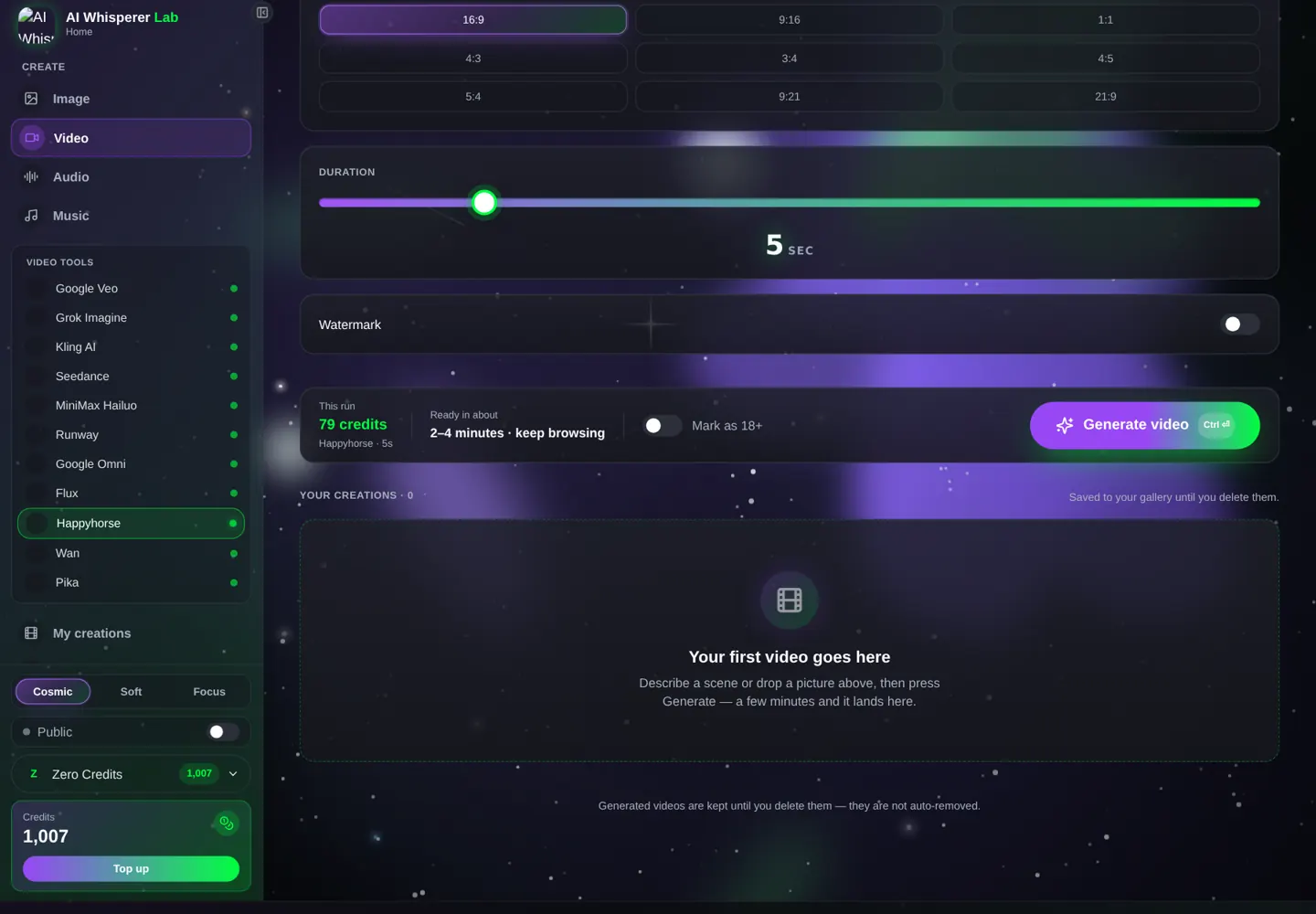
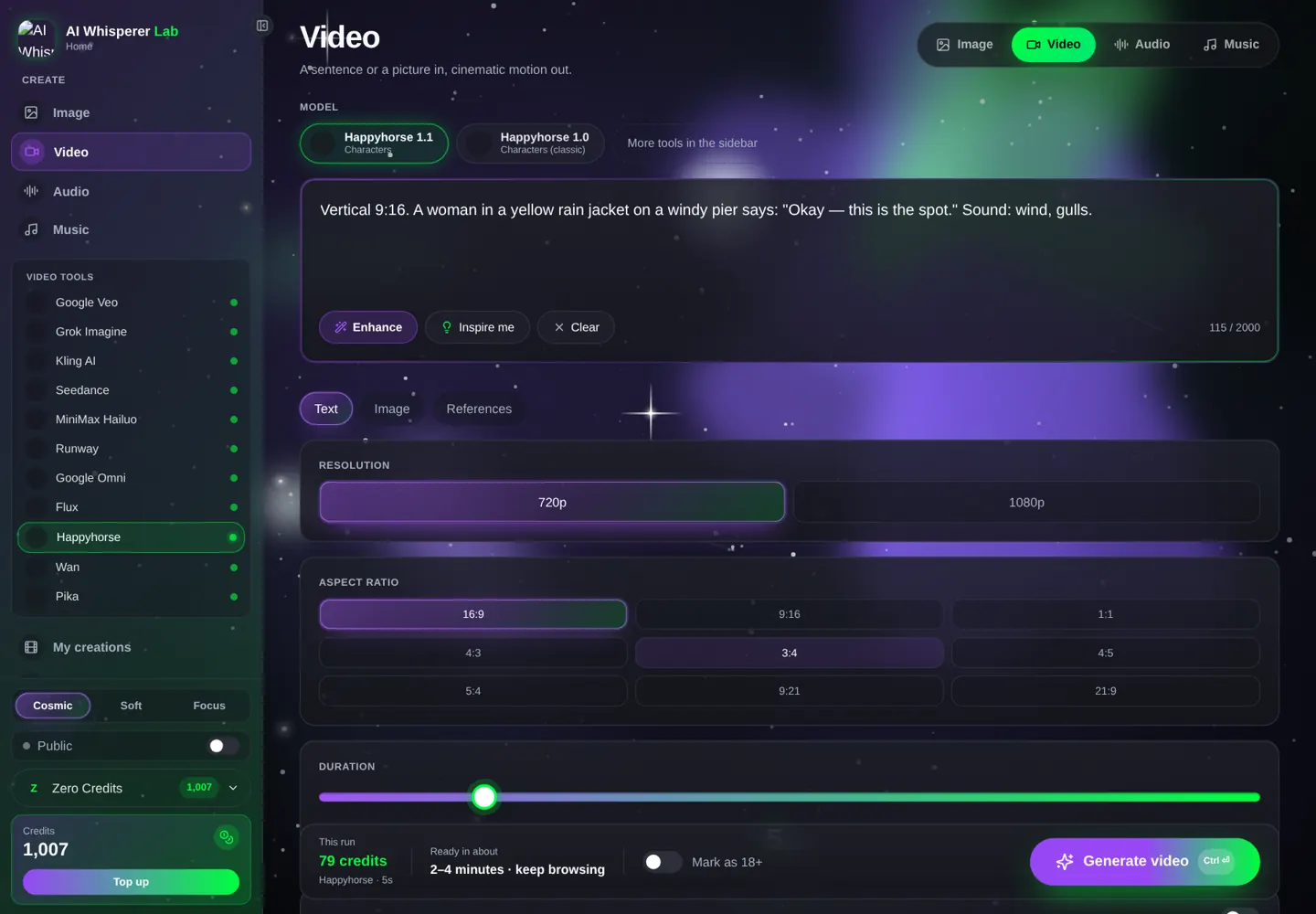
Your first HappyHorse clip, step by step
- Open the video studio, pick Happyhorse, then 1.1.
- 720p, 6 seconds, 9:16.
- Paste the prompt below — about 95 credits for 6 s.
- Generate. Check the mouth on the line; if it is rushed, add two seconds.
- Upload a photo of yourself as character1 and run it again.
Vertical 9:16. A woman in a yellow rain jacket on a windy pier, medium shot, looks to camera and says: "Okay — this is the spot." Static camera. Sound: wind, gulls, water slapping the posts.
12 prompts you can run right now
Talking, one person
A news anchor at a clean desk reads the evening headline: "Tonight: the town that runs on sunlight." Studio light, static medium shot. Sound: synced studio audio, a soft sting.
Close-up of a chef plating a dish, steam rising, he says: "Service." Warm kitchen light. Sound: pan sizzle, soft kitchen ambience.
A teenager in a hoodie holds a phone to the camera in a bedroom and says in German: "Das war's. Fertig." Ring light, static. Sound: room tone.
Talking, two or more people
Two coworkers at a standing desk, 0–3s: character1 says: "Did you ship it?" 3–6s: character2 grins: "Ten minutes ago." Office window light, static two-shot. Sound: keyboards, a distant phone.
Three friends on a couch, 0–3s: character1 says in Japanese: 「見た?」 3–6s: character2 nods and replies: 「うん、すごかった」 6–8s: character3 laughs. Warm lamp light, slow push-in. Sound: TV murmur.
A mother and a small child at a kitchen table, 0–4s: the child asks in Korean: "이거 뭐예요?" 4–8s: the mother smiles and says: "우리 저녁이야." Morning light, static. Sound: cutlery, a kettle.
UGC and ads
Selfie-style vertical 9:16, a man in a car seat holds a small skincare bottle up and says: "Three days. Look at this." Daylight through the windshield, handheld. Sound: car interior, a click.
character1 unboxes wireless earbuds on a wooden desk, lifts one to the camera and says: "Lighter than I thought." Bright clean light, static. Sound: cardboard, a case click.
A barista slides a cup across the counter and says in Cantonese: "你嘅咖啡。" Café light, static medium. Sound: espresso machine, chatter.
Motion beats
The door swings open slowly, a figure steps through after a beat, then the camera settles into a medium shot as she says: "I'm home." Hallway lamp light. Sound: the door, keys.
Handheld tracking shot following a woman through rain-slicked streets, shop lights on the pavement, she turns and says: "Almost there." Sound: rain, footsteps.
Two hands shake over a market stall, the camera tilts up to two smiling faces, one says in Mandarin: "成交。" Bright noon light. Sound: market noise.
Timing dialogue so the mouths match
The single most useful habit with HappyHorse is writing the seconds. A line of eight to twelve words takes about three seconds to say naturally. Give each line its own window (0–3s, 3–6s, 6–9s) and leave a half-second of silence between speakers; the model uses that gap to cut or to turn the head. Cram two lines into three seconds and the second speaker starts before the first one finishes — the classic 'rushed mouth' look.
Language is set by the line itself: write the words in French and the model speaks French with French mouth shapes. Do not translate in the prompt ("she says hello in French"); write the actual French. Accents can be hinted ("in British English"), and tone words work well at the start of a line: (whispering), (laughing), (annoyed).
Music and ambience are part of the audio line. If you want a music bed, name the mood and instrument ("soft acoustic guitar, low"); if you want none, say "no music" — otherwise the model may add a generic track under your dialogue.
Indexed references: how to keep faces consistent
Upload one clear photo per person, front-facing, similar light. The upload order sets the index. Then write the script with those indexes. If two characters swap faces in the result, the prompt named them out of order — fix the numbers, not the photos. For a recurring creator persona, keep a folder of three photos (front, three-quarter, laughing) and reuse them across every clip.
Nano Banana Pro → HappyHorse (a spokesperson who does not exist)
Photorealistic portrait of a friendly presenter in her forties, short grey hair, teal blouse, plain grey studio backdrop, soft light, 1:1.
character1 in a bright studio, medium shot, static, says: "Welcome to the Lab. Let's make something." Sound: studio room tone.
HappyHorse → Kling 3.0
HappyHorse nails the talking close-up; when the same scene needs a wide establishing shot with camera moves, generate that in Kling 3.0 with the same reference images and cut the two together.
Mistakes that waste credits
- No audio line. Silent output. Always write the sound.
- Unindexed references. "The woman" is ambiguous with three uploads. Use character1.
- Long lines. Twelve words per line, three seconds each.
- Vague camera. "Nice shot" is not a camera. "Static medium" is.
- Choosing the ratio after. Nine ratios are available; set the right one first.
What it costs, what it takes
| Settings | Credits | About | Typical wait |
|---|---|---|---|
| 5 s | 79 | $0.79 | 1–3 min |
| 10 s | 157 | $1.57 | 2–4 min |
| 15 s | 236 | $2.36 | 3–5 min |
Same price at 720p and 1080p in the Lab. Credits never expire.
FAQ
Which languages does HappyHorse lip-sync?
English, Mandarin, Cantonese, Japanese, Korean, German and French.
How many people can be in a scene?
Up to nine indexed character references (character1 … character9). Two or three is the sweet spot for clean dialogue.
How long can a clip be?
3 to 15 seconds.
Does it generate the audio itself?
Yes — dialogue, effects and ambience in the same pass, phonetically matched to the mouths.
Can I animate my own photo?
Yes. Upload it as character1 or as the start image and describe motion and audio.
Do I need an Alibaba account?
No. HappyHorse 1.1 runs in the Lab per clip.
Related tools
Kling 3.0 for multi-shot dialogue with camera moves · Grok Imagine Video for fast talking clips from a still · Wan 3.0 for cheap long B-roll · Nano Banana Pro for the faces. Same studio, one wallet.